
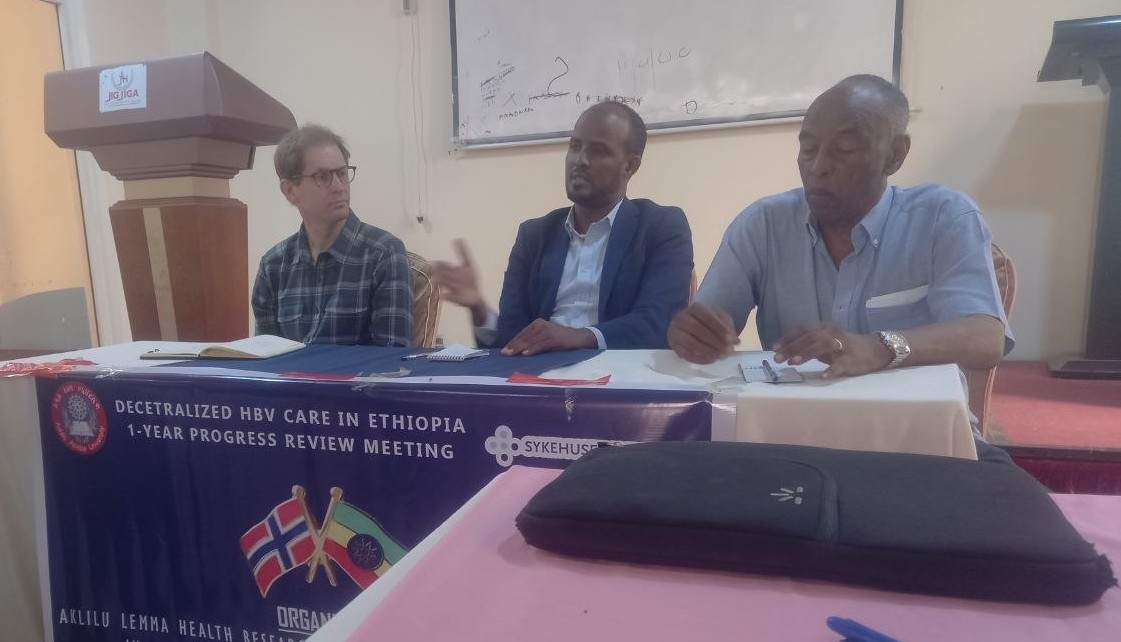
Decentralized Hepatitis B Care: Somali Regional State Review Meeting Findings
etnohep2026-05-26T08:58:44+00:00
By
etnohep
Program Update · Somali Regional State
Review Meeting Findings
EtNoHep Group in collaboration with Regional & Federal Health Bureaus
Degehabur · Gode · Sitti 2026 2,327 patients enrolled
Since launch, three hospitals in the Somali Region have been piloting decentralized Chronic Hepatitis B (CHB) care, enrolling 2,327 patients to date. This review brings together findings from implementing teams, regional stakeholders, EtNoHep group — mapping what works, what doesn’t, and the path forward.
Challenges
Barriers shaping care delivery
Geographic isolation
DGH covers 61,130 km²; Sitti’s catchment extends up to 300 km. Poor roads and seasonal flooding make facilities routinely inaccessible.
Pastoral mobility
Seasonal migration breaks treatment continuity. Combined with weak mobile networks, patients become unreachable — a cycle of disengagement.
Misconceptions
CHB is widely viewed as benign or digestive. Traditional remedies delay care. Pregnant women face compounded stigma and barriers.
What’s working
Facilitators driving progress
Strong leadership
At DGH, CEO-level involvement secured free investigations, ambulance access, and expanded clinic space. Gode mandated free investigations from day one.
Adaptive innovation
DGH digitalized tracking and ran 44+ weekend campaigns reaching 47,000+ people. Sitti launched a satellite clinic via PPP. Gode used kebele networks for tracing.
Forward strategy
Seven agreed recommendations
- 1Health system integration — Appoint Focal Persons at health centers, mobilizing HEWs and community volunteers through a hospital → FP → HEW → volunteer → patient chain.
- 2Satellite clinics — Treat-All model for remote areas (basic CHB + HIV testing); Standard/Simplified model for accessible areas with referral for advanced tests.
- 3Smarter registration — Capture sub-kebele and clan name at enrollment to enable logistical tracing, with strict confidentiality protocols.
- 4Clan & religious leaders — Imams deliver messages at Friday prayers; clan leaders support stigma reduction and awareness (not direct patient disclosure).
- 5Culturally adapted content — Audio-visual materials in local languages via WhatsApp, radio, community drama forums, and health facility screens.
- 6Digital scale-up — Expand DGH’s digital tracking and appointment reminder system to Sitti and Gode hospitals.
- 7Staff HBV vaccination — Ensure all healthcare workers in CHB care settings are vaccinated, reinforcing institutional commitment.
Action points
Who does what, by when
| # | Action | Responsible | Timeline |
|---|---|---|---|
| 1 | Assign Focal Persons at health centers; link to hospital tracing chain | Woreda / RHB | 3 months |
| 2 | Enroll health centers as satellite clinics (Treat-All or Simplified model) | Hospitals / RHB | 4 months |
| 3 | Update registration forms to capture sub-kebele and clan name | Implementing hospitals | 1 month |
| 4 | Engage Muslim Council and clan leaders for awareness & stigma reduction | RHB / Woreda | 3 months |
| 5 | Produce and distribute local-language CHB audio-visual content | EtNoHep / Hospitals / RHB | 4 months |
| 6 | Expand digital tracking and appointment reminders to Sitti and Gode | Implementing team | 3 months |
| 7 | Vaccinate all CHB care healthcare workers against HBV | RHB / Hospitals | 2 months |
Conclusions
Three pillars of the path forward
System integration
Embed CHB care into existing health infrastructure — no vertical program silos.
Decentralization
Bring services to communities. Satellite clinics tailored to local realities reduce loss to follow-up.
Community engagement
Clan networks, religious platforms, and culturally adapted education reduce stigma and build demand.
Implementation of the seven agreed action points, monitored by the RHB and the EtNoHep group, is critical to translating these findings into measurable improvements in CHB coverage, treatment continuity, and health outcomes across the Somali Regional State.
EtNoHep Group · Decentralized CHB Care Programme
Somali Regional State, Ethiopia · 2026
Somali Regional State, Ethiopia · 2026
EtNoHep

Leave a Reply